Best Blackout Curtains for Bedrooms
Learn how to choose blackout curtains by light blocking, fabric density, size, mounting, color, maintenance, and renter-friendly setup.
Editorial note
RestWise Guide evaluates products using publicly available specifications, feature comparisons, manufacturer information, and editorial research. We do not claim hands-on testing unless explicitly stated.
Affiliate disclosure
This page contains affiliate links. As an Amazon Associate I earn from qualifying purchases.
Product recommendations
Our Picks
These recommendations are based on public product information, feature comparison, and editorial research. RestWise Guide does not claim hands-on testing unless explicitly stated.
Best Overall
NICETOWN Thermal Insulated Grommet Blackout Curtains
NICETOWN
Best suited to readers who want a widely available, straightforward blackout curtain pair with grommet installation and broad bedroom use.
Practical strengths
- Grommet-top design is familiar and easy to hang on common curtain rods.
- Broad size and color availability makes matching bedroom windows simpler.
- A practical baseline pick for shoppers comparing blackout curtains for the first time.
May not suit
May still need careful rod placement and wider panel coverage to reduce light gaps around the window.
Best Maximum Blackout / Lined
NICETOWN 100% Blackout Window Curtain Panels
NICETOWN
Useful for shoppers who specifically want a lined curtain construction for stronger light control than a basic room-darkening panel.
Practical strengths
- Black-liner construction gives it a distinct role from simpler single-fabric panels.
- Bedroom-friendly panel format works for standard curtain rod setups.
- A useful option for readers who want lighter face colors with stronger backing.
May not suit
May be heavier than basic panels and still depends on proper sizing and mounting to control edge gaps.
Best Value
Deconovo Back Tab and Rod Pocket Blackout Curtains
Deconovo
A strong option for readers who want flexible hanging choices without paying for custom drapery. Compared with grommet-only panels, the back-tab and rod-pocket design gives more styling flexibility for bedrooms.
Practical strengths
- Back-tab and rod-pocket options support different bedroom looks.
- Two-panel format is practical for common bedroom windows.
- A useful value comparison against grommet and lined blackout panels.
May not suit
May not be the right fit for shoppers who prefer the easiest sliding movement of grommet curtains.
Best Style / Bedroom-Friendly
100% Blackout Shield Linen Textured Blackout Curtains
100% Blackout Shield
Best suited to shoppers who want a softer linen-textured look while still shopping for a blackout-labeled bedroom curtain.
Practical strengths
- Textured fabric direction can look warmer than plain utility blackout panels.
- Back-tab styling supports a cleaner bedroom presentation.
- A useful option for readers balancing appearance with light control.
May not suit
May not suit shoppers who want the lowest-cost panel or a simple grommet-only setup.
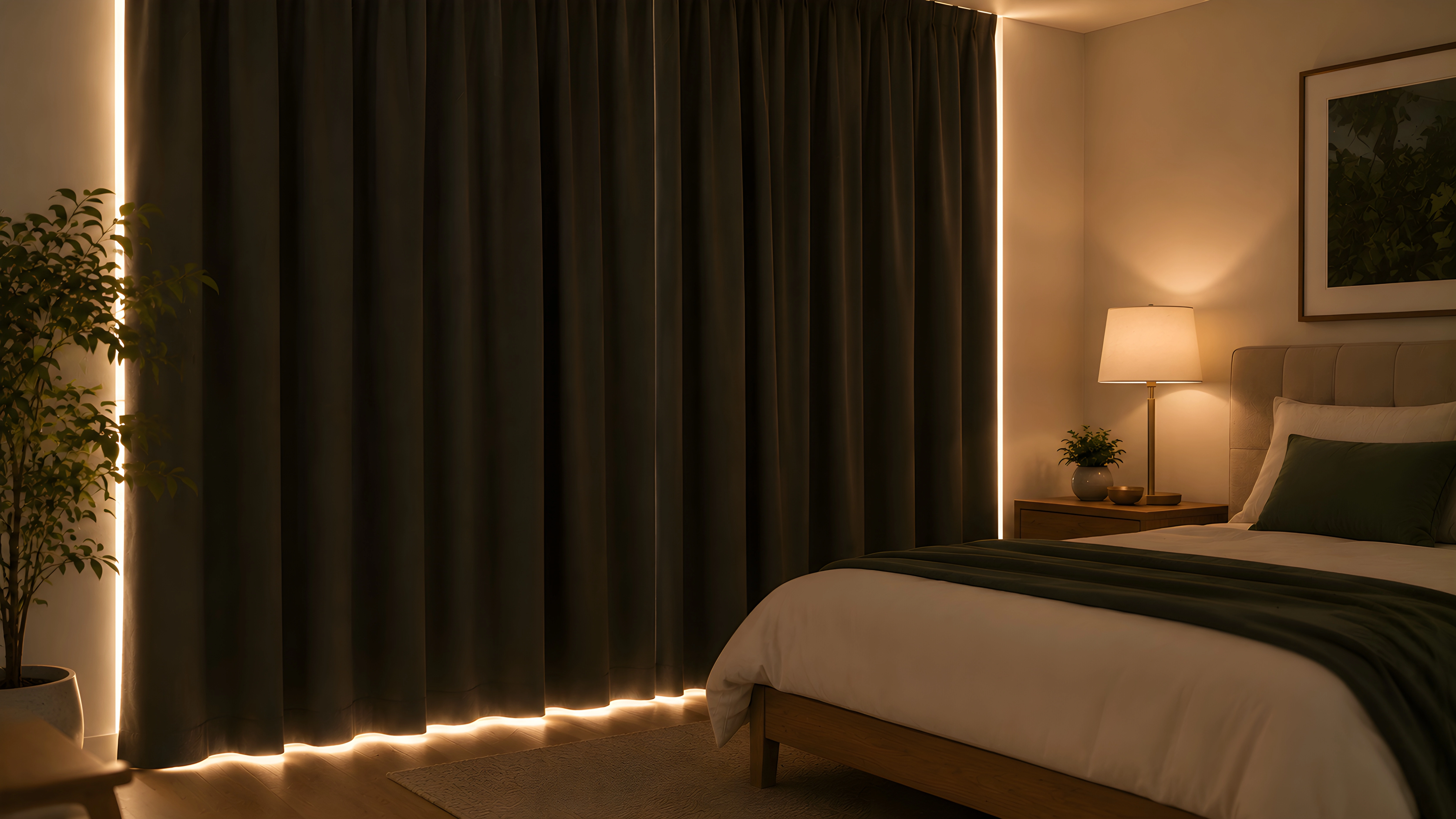
Blackout curtains can make a bedroom feel calmer by reducing streetlights, sunrise glare, and light from nearby buildings. The key is not only fabric. Mounting height, width, side gaps, and color all affect performance.
Quick Decision Summary
Choose curtains that extend beyond the window frame, use dense fabric or a true blackout liner, and can be mounted high and wide. If you rent, consider tension rods, no-drill brackets, or removable side solutions, but check whether they can support the curtain weight.
Light Blocking
The biggest leaks usually happen at the top, sides, and center seam. Wider panels and wraparound rods can help. Floor-length panels reduce lower gaps. A dense liner is often more important than decorative fabric alone.
Thermal Performance
Some blackout curtains can reduce heat transfer around windows, especially if they are heavy and well fitted. They are not a replacement for window repair, weatherstripping, or efficient glass, but they may improve comfort near drafty windows.
Noise Expectations
Blackout curtains are not soundproofing. Heavy fabric can slightly soften echo or minor sound, but traffic, voices, and impact noise require different solutions. Avoid exaggerated sound-blocking claims.
Fabric Density and Color
A tight weave and backing layer help block light. Dark colors may hide light better, but white or light-colored blackout curtains can still work if the liner is strong.
Curtain Size
Measure the window and add extra width. A common approach is choosing total panel width at least 1.5 to 2 times the window width for fullness and side coverage. Mounting above the frame helps reduce top light.
Mounting
Use hardware that can support the weight. Wraparound rods reduce side gaps. Ceiling tracks can provide strong coverage but require more installation effort.
Renter-Friendly Options
Renters can consider tension rods, removable brackets, or temporary blackout liners. The tradeoff is support and gap control. Lightweight solutions may be easier to install but less complete.
Maintenance
Check washing instructions. Some lined curtains are machine washable, while others require spot cleaning or dry cleaning. Dust buildup can be noticeable in bedrooms, so maintenance matters.
Measuring Guide
Measure window width, desired rod width, window height, and mounting height. Decide whether panels should stop at the sill, below the sill, or near the floor. For maximum darkness, wider and longer usually works better.
Buying Mistakes to Avoid
Do not buy panels exactly the width of the window. Do not ignore rod placement. Do not expect curtains to solve major noise. Avoid heavy panels with weak hardware.
Conclusion
The best blackout curtains combine dense material with smart sizing and mounting. Treat the window as a light-leak system, not just a place to hang fabric.
RestWise Guide may earn a commission from qualifying purchases made through links on this site, at no additional cost to you.
FAQ
Do blackout curtains soundproof a bedroom?
No. Heavy curtains may slightly soften some room noise, but they should not be treated as soundproofing.
Should blackout curtains be wider than the window?
Usually yes. Extra width helps reduce side light gaps and gives a fuller drape.
Are dark curtains always better?
Darker colors can help, but liner quality, weave, and mounting coverage are often more important.