Best Bedroom Humidifiers for Comfortable Overnight Air
A responsible guide to bedroom humidifiers, including mist type, coverage, noise, tank size, cleaning, humidistats, filters, and mold prevention.
Editorial note
RestWise Guide evaluates products using publicly available specifications, feature comparisons, manufacturer information, and editorial research. We do not claim hands-on testing unless explicitly stated.
Affiliate disclosure
This page contains affiliate links. As an Amazon Associate I earn from qualifying purchases.
Product recommendations
Our Picks
These recommendations are based on public product information, feature comparison, and editorial research. RestWise Guide does not claim hands-on testing unless explicitly stated.
Best Overall
LEVOIT OasisMist 1000S Smart Ultrasonic Cool Mist Tower Humidifier
LEVOIT
Best suited to readers who want a capable smart humidifier for a bedroom and prefer a larger, more feature-rich tower format.
Practical strengths
- Smart feature set gives the guide a premium connected option.
- Tower design creates a distinct large-room presence.
- Good fit for readers comparing higher-capacity bedroom humidifiers.
May not suit
May be more humidifier than a small bedroom needs.
Best Smart / Large Bedroom
Dreo 6L Smart Humidifier for Bedroom, Warm & Cool Mist, Quiet 60hr Runtime, HM713S
DREO
A strong fit for shoppers who want a smart humidifier with broad comfort controls and a large-bedroom-friendly runtime profile.
Practical strengths
- Smart controls create a distinct feature-rich option.
- Large-tank design is useful for longer overnight use.
- Works well as the article's advanced-control pick.
May not suit
Premium controls may not matter to buyers who want a very simple unit.
Best Value / Compact
Pure Enrichment MistAire Ultrasonic Cool Mist Humidifier
Pure Enrichment
A practical compact pick for readers who want a simpler bedroom humidifier without moving up to a larger smart tower.
Practical strengths
- Compact footprint makes it easy to place on a nightstand or dresser.
- Value positioning gives the guide a more accessible entry-level choice.
- Straightforward bedroom use helps balance the larger units.
May not suit
Less capacity and fewer controls than the larger smart models.
Best Easy-to-Clean
Honeywell Germ Free Cool Mist Humidifier HCM-350
Honeywell
Best suited to readers who care most about straightforward upkeep and want a familiar evaporative-style bedroom humidifier.
Practical strengths
- Easy-clean positioning is a clear editorial role.
- Adds a maintenance-focused alternative to the smart ultrasonic picks.
- Useful for readers who prioritize regular cleaning and filter-based operation.
May not suit
Filter upkeep may be less appealing to readers who want a filterless design.
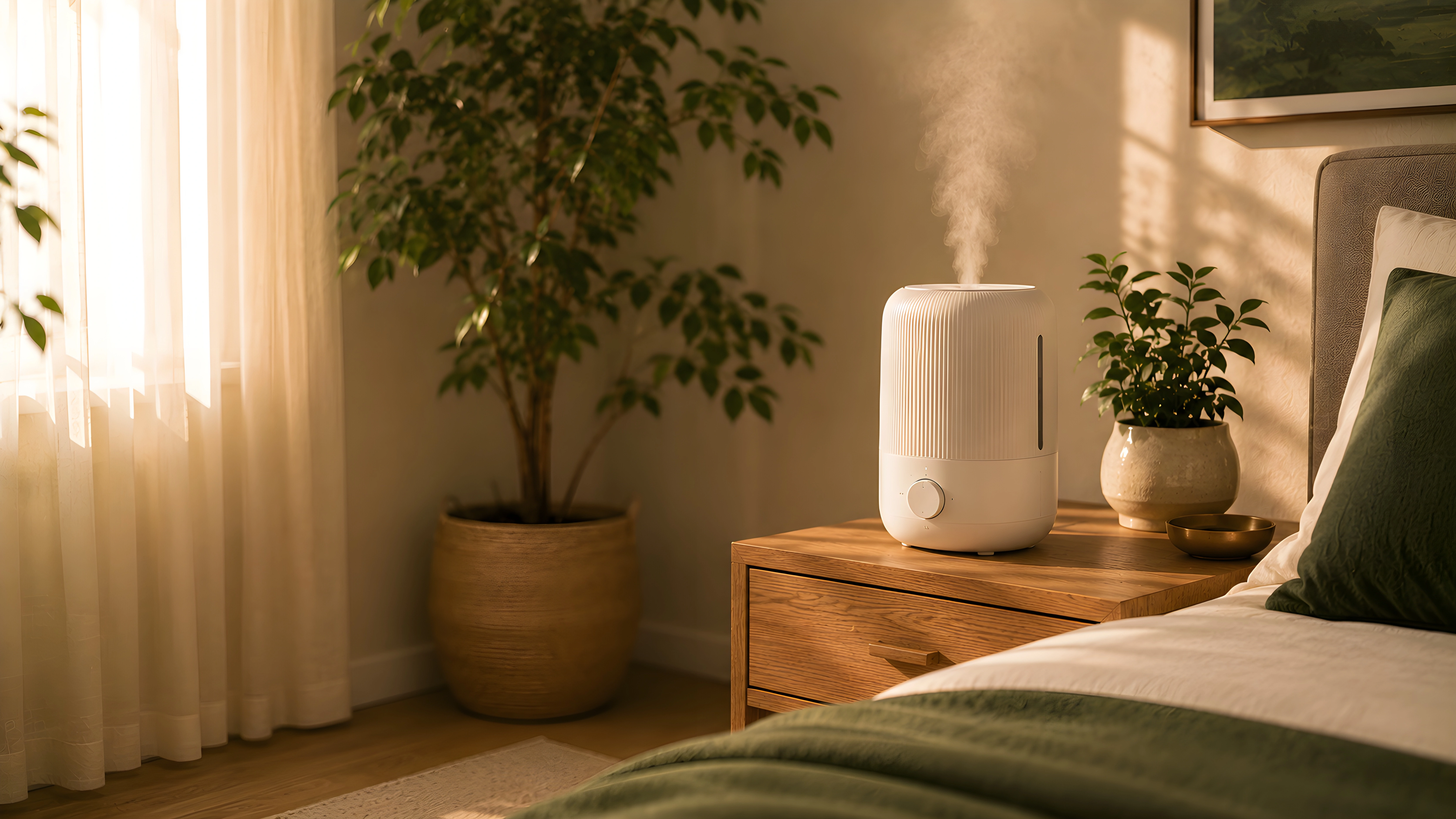
A bedroom humidifier can make dry overnight air feel more comfortable, especially in winter or arid climates. It can also create problems if oversized, poorly cleaned, or used in an already damp room. The best choice balances comfort with hygiene and control.
Quick Decision Summary
Choose a humidifier sized for the room, quiet enough for sleep, easy to clean, and equipped with automatic shutoff. A humidistat is helpful if you want better control. Avoid running a humidifier without monitoring humidity.
Cool Mist Versus Warm Mist
Cool mist humidifiers are common for bedrooms and avoid heating water to produce visible mist. Warm mist units can feel soothing to some users but involve hot water or steam, which adds safety considerations around children and pets.
Room Coverage
Do not oversize automatically. Too much moisture can create condensation and support mold growth. Match the unit to bedroom square footage and start conservatively.
Noise
For sleep, low noise matters. Ultrasonic models can be quiet, while evaporative units may use fans. Some people prefer a soft fan sound; others need near silence.
Tank Size
A larger tank can run longer but is heavier to carry and clean. Look for an opening wide enough to reach inside. Awkward tanks tend to be neglected.
Cleaning
Cleaning is not optional. Empty and refresh water frequently, follow manufacturer cleaning instructions, and let parts dry when not in use. Mineral buildup and stagnant water are common problems.
Automatic Shutoff and Humidistat
Automatic shutoff protects the unit when the tank runs dry. A humidistat helps prevent over-humidifying. If the humidifier lacks one, consider a separate room hygrometer.
Filter Requirements
Filtered evaporative models require replacement filters. Ultrasonic models may need demineralization cartridges depending on water quality. Include filter cost in the purchase decision.
Distilled Water Considerations
Hard water can leave mineral dust with some ultrasonic humidifiers. Distilled or demineralized water can reduce this, but it adds cost and effort.
Mold and Hygiene Prevention
Keep indoor humidity moderate. Watch for condensation on windows, damp fabric, musty smell, or visible growth. If these appear, stop use and address the moisture source.
Buying Mistakes to Avoid
Do not buy a hard-to-clean tank. Do not run the unit continuously without checking humidity. Do not ignore filter costs. Avoid placing the unit where mist lands directly on bedding, wood, or electronics.
Conclusion
The best bedroom humidifier is controlled, cleanable, quiet, and appropriately sized. Moisture can improve comfort, but only when managed responsibly.
RestWise Guide may earn a commission from qualifying purchases made through links on this site, at no additional cost to you.
FAQ
What humidity level is best for a bedroom?
Many homes aim for a moderate indoor range around 30 to 50 percent, but climate, building conditions, and health guidance can vary.
Do humidifiers need daily cleaning?
Water should be refreshed often and tanks should be cleaned according to the manufacturer instructions to reduce buildup and microbial growth.
Is warm mist better than cool mist?
Neither is universally better. Cool mist is common for bedrooms, while warm mist involves heat and may not be ideal around children or pets.